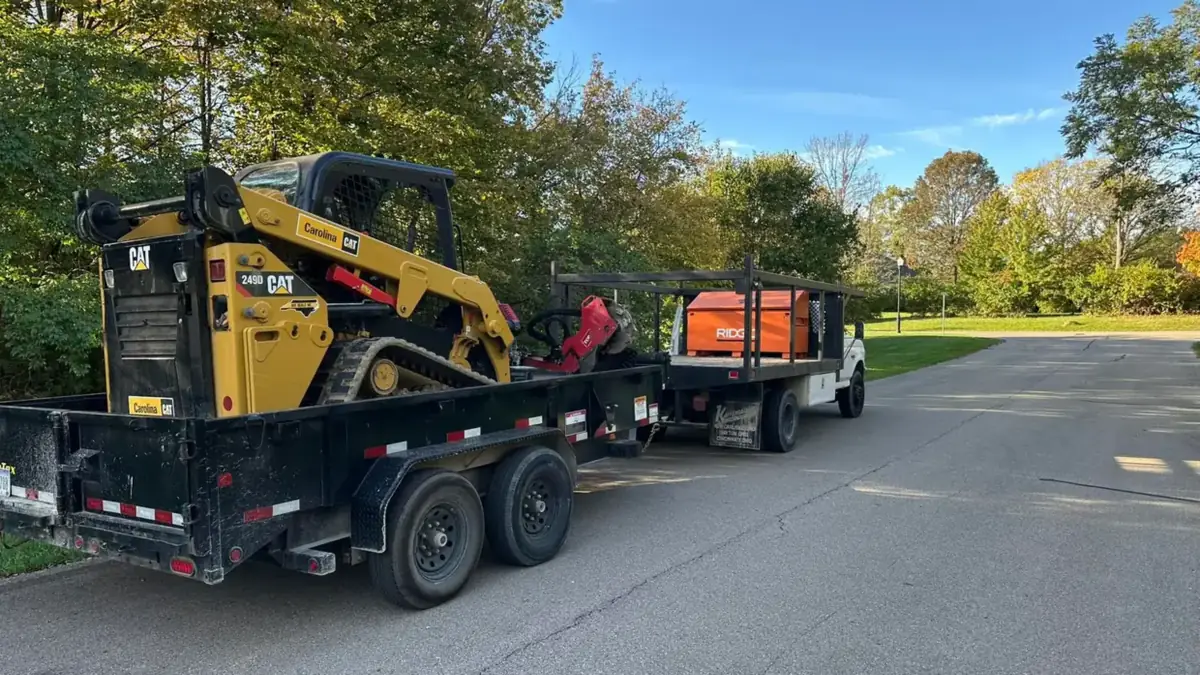
You're planning a dig, a regrade or a drainage job, and somebody mentioned Ohio EPA stormwater paperwork. It's a fair thing to ask about. Any job that strips grass and opens up soil can send mud down the driveway, into the storm drain and on to the nearest creek after one hard rain. Whether your project needs any sign-off depends on how much ground it opens up and which city, township or county you live in. Rules vary by city and county, so check with your county before you start. You'll find who to call, what to ask them, and the erosion control we put on every earth-disturbing job below. That last part doesn't change with the answer you get.
Why Loose Soil Is the Whole Issue
Bare soil moves. Strip the sod off a backyard, get a hard rain that night, and a lot of that dirt ends up somewhere it shouldn't: the street, the storm sewer, a neighbor's yard, the creek at the bottom of the hill. Sediment clouds the water, smothers the creek bed and carries fertilizer and other pollutants along with it. It clogs storm drains too, which is how a mud problem on one lot turns into a flooding problem for the whole street. Our heavy Warren County clay makes it worse. Clay doesn't soak up a downpour, so the water runs across the open ground and takes the loose top layer with it. That's why erosion control comes up at all when you dig, and it's why we build it into every job we dig.
Who to Call Before You Dig
Start with the people who know your address. You can read the statewide stormwater material on the Ohio EPA site, but the answer for your lot comes from local offices. Call your city or township zoning or engineering office first and ask whether your project needs any stormwater or grading sign-off. Then ask the Warren County Soil and Water Conservation District (SWCD) what applies to a dig your size. If you're in an HOA, ask your HOA what it wants to see before grading starts. Outside Warren County, the same questions go to your own county's soil and water district. None of these calls take long, and a homeowner asking before the work starts gets a much friendlier answer than one calling after a neighbor complains about mud.
What to Ask Them
Go in with your numbers. Have the square footage of ground that will be opened up, the distance from the work to the nearest creek, ditch, pond or storm drain, and the number of weeks the soil will sit bare. Mention whether dirt is being hauled off or brought in. Then ask the plain questions. Does my project need any stormwater or grading sign-off? At what size does that change? Do you want to see an erosion control plan before work starts? Is there anything about my street or my creek I should know? Write down who you talked to, the date and what they told you. If you hire us, hand us that note and we'll pick it up from there.
A big regrade, a large excavation, or a project that combines several kinds of earth-disturbing work is more likely to need paperwork than a small, contained dig. A small job still gets asked about. Don't assume a project is too small to matter until someone local has told you so.
Why the Phone Call Is Cheaper Than Skipping It
A job that gets stopped halfway costs you twice. You're paying for a crew to wait, and the bare dirt keeps washing out while it waits. Mud that ends up in the street or a neighbor's yard is yours to clean up, and that's a bad way to meet the neighbors. Silt fence, a stabilized entrance and fast cover on bare soil are cheap next to any of that. They protect your own yard during construction just as much as they protect the creek. A phone call before the dig costs nothing. Finding out after the grass is gone costs time and money, so make the call first.
The Erosion Control We Put on Every Dig
Whatever answer you get, Shawn's Landscape & Design runs the same controls on any job that opens up soil. Before we start, we check with your city or county and the SWCD on what applies to your project, and we tell you what they said. If they want paperwork, we handle it with you. Silt fence goes up on the downhill side of the work. Trucks come and go over a stabilized entrance, so mud stays off your driveway and out of the street. Bare ground gets covered and stabilized as soon as each section is done, so no part of the yard sits open waiting for the job to wrap up. When we finish, we restore the disturbed areas so nothing is left open for the next storm. Every base layer is engineered, not eyeballed, and the erosion control around it gets the same care. That applies to excavation and site prep, regrading and drainage installation alike.
Bottom Line: Ask First, Then Dig Clean
Whether your yard project needs any stormwater sign-off depends on how much ground it opens up and where you live. Rules vary by city and county, so check with your county and the Warren County SWCD before you start, and write down what they tell you. Either way, the dirt should stay on your lot. That means silt fence on the low side, a clean entrance for the trucks and bare ground covered fast. Pricing comes from an on-site look, not a phone guess. Call (513) 849-3279 and we'll walk the job, and tell you what we'd ask your county. Estimates are free, and we answer within 24 hours.