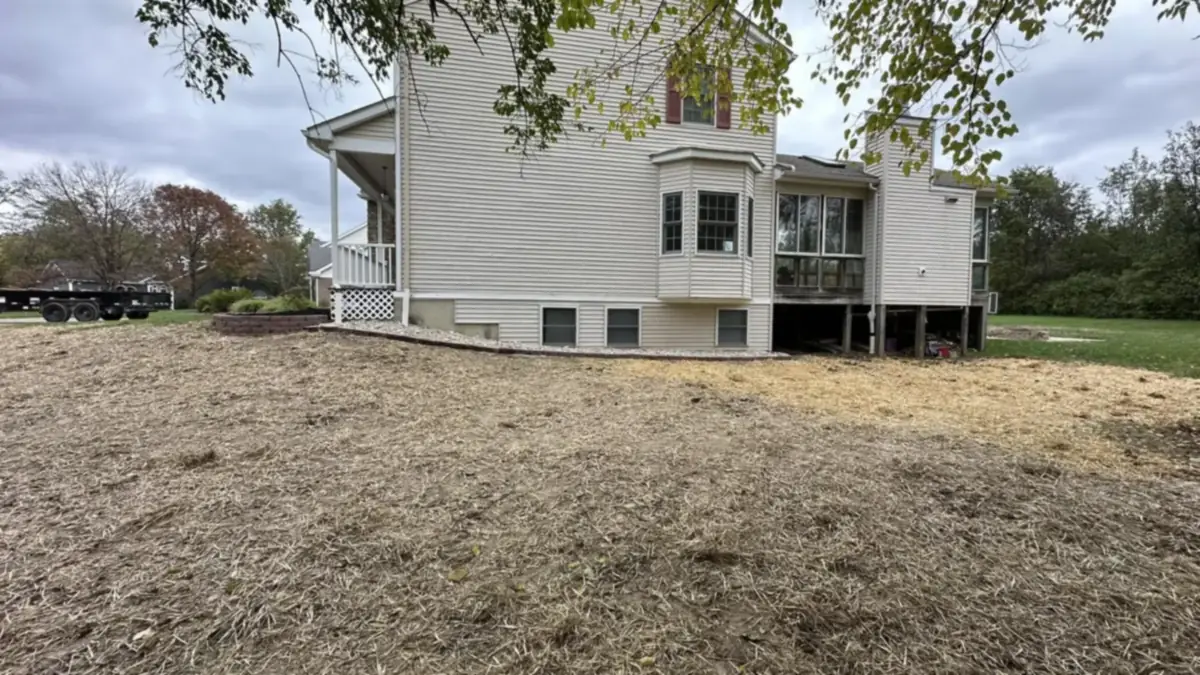
It's frustrating to walk into your backyard on a sunny afternoon in Maineville and feel the lawn squish like a wet sponge under your feet. It hasn't rained in three days and the surface looks green, but the ground is completely saturated. Your mower leaves deep tire ruts, your kids can't play out there without getting covered in mud, and mosquitoes seem to breed out of thin air even though you can't see any standing water. If that sounds familiar, the usual cause is a perched water table, a hidden, shallow layer of trapped moisture just below the surface. It behaves differently from surface runoff or a high regional groundwater table. It's a common problem across Southwest Ohio, and fixing it takes targeted excavation.
How a Perched Water Table Forms
To see what's happening in your yard, look at how the soil is layered. In a healthy, well-draining soil profile, rainwater soaks into the topsoil and keeps moving down through the subsoil until it reaches the regional water table, which is often dozens of feet below ground. A perched water table forms when a dense, nearly impermeable layer of soil or rock just below the surface stops that downward movement. In Warren County, that layer is usually a dense band of Miamian clay or a naturally occurring fragipan. When rain hits it, the water can't go any further. It "perches" on top of the clay and saturates the thin layer of topsoil above. According to soil science data from the OSU Extension, these restrictive layers can cut deep soil permeability to nearly zero. What you end up with is a shallow, localized pocket of water sitting right in your grass's root zone, keeping the yard waterlogged from the bottom up.
Construction Compaction in Maineville Subdivisions
Perched water tables can occur naturally, and modern residential construction makes them much worse. Maineville and Loveland have seen fast residential growth over the last two decades, with former farm fields turned into master-planned subdivisions. To cut roads and grade the lots, developers bring in heavy earth-moving equipment: bulldozers, scrapers, and big tracked excavators. All that weight crushes the native subsoil, closes up its natural pore spaces, and turns already-dense clay into a hardpan that's close to concrete. Once the house is built, a thin layer of topsoil and sod gets rolled out over that compacted clay. For the first year, the yard looks perfect. Then the rain comes. The thin topsoil works like a shallow sponge sitting on a solid dinner plate. The sponge fills up, the water hits the compacted plate, and a perched water table forms. Standard landscaping can't get through that compaction layer.
What It Does to Your Foundation
A squishy lawn is annoying. The bigger problem is what a perched water table can do to your house. Water is heavy, and trapped subsurface water follows the path of least resistance. Because a perched water table sits so close to the surface, it almost always runs into the disturbed backfill soil around your basement or crawlspace walls. If the subsurface grade, meaning the angle of the restrictive clay layer, tilts toward your home, that trapped water slowly migrates straight against your foundation. That builds hydrostatic pressure. The pressure finds small weaknesses in poured walls or block masonry and eventually forces moisture into your basement. Winter makes it worse. With our regional frost line reaching 32 inches, that trapped water freezes and expands, and it wedges against your foundation footer every time it does.
Diagnosing the Problem: The Soil Auger Test
How can you be sure it's a perched water table and not poor surface grading? The most reliable check is a soil auger test, the same basic method used in geotechnical surveys. Take a hand auger or a post-hole digger and dig a hole about 18 to 24 inches deep in the wettest, softest part of your yard. That opens up the soil profile so you can see each layer. You'll usually cut through the top few inches of dark, organic soil easily before you hit a dense, gray or rust-mottled clay layer that resists the shovel. Leave the open hole alone for 24 hours. It will fill with water, and the water will seep in from the sides of the hole, right where the topsoil meets the clay. Seepage from the sides is the visual proof of a perched water table draining into the hole you just dug.
Bottom Line: What Happens If You Wait
Left untreated, a perched water table eventually kills the lawn and keeps degrading the soil. Long stretches of waterlogged, low-oxygen conditions rot grass roots and invite fungal disease across the yard. The bigger risk is the foundation. If that hidden subsurface water keeps pressing against your home through Southwest Ohio's 50-plus freeze-thaw cycles a year, you're risking serious structural damage and water in the basement. Excavating and replacing a bowed basement wall costs far more than installing proper yard drainage now.
Dumping topsoil on top or planting thirstier grass won't fix a perched water table. The water needs a way out, and that means breaking through the restrictive layer. At Shawn's Landscape & Design, we do that with heavy excavation and site prep. We dig deep trenches through the compacted clay hardpan and install high-capacity French drains bedded in washed ODOT-spec #57 clear stone. The drains catch the perched water as it moves sideways through the soil and lower the saturation zone. Then professional yard grading and regrading sends both surface runoff and the water underground away from your foundation. Call (513) 849-3279 for a free estimate.