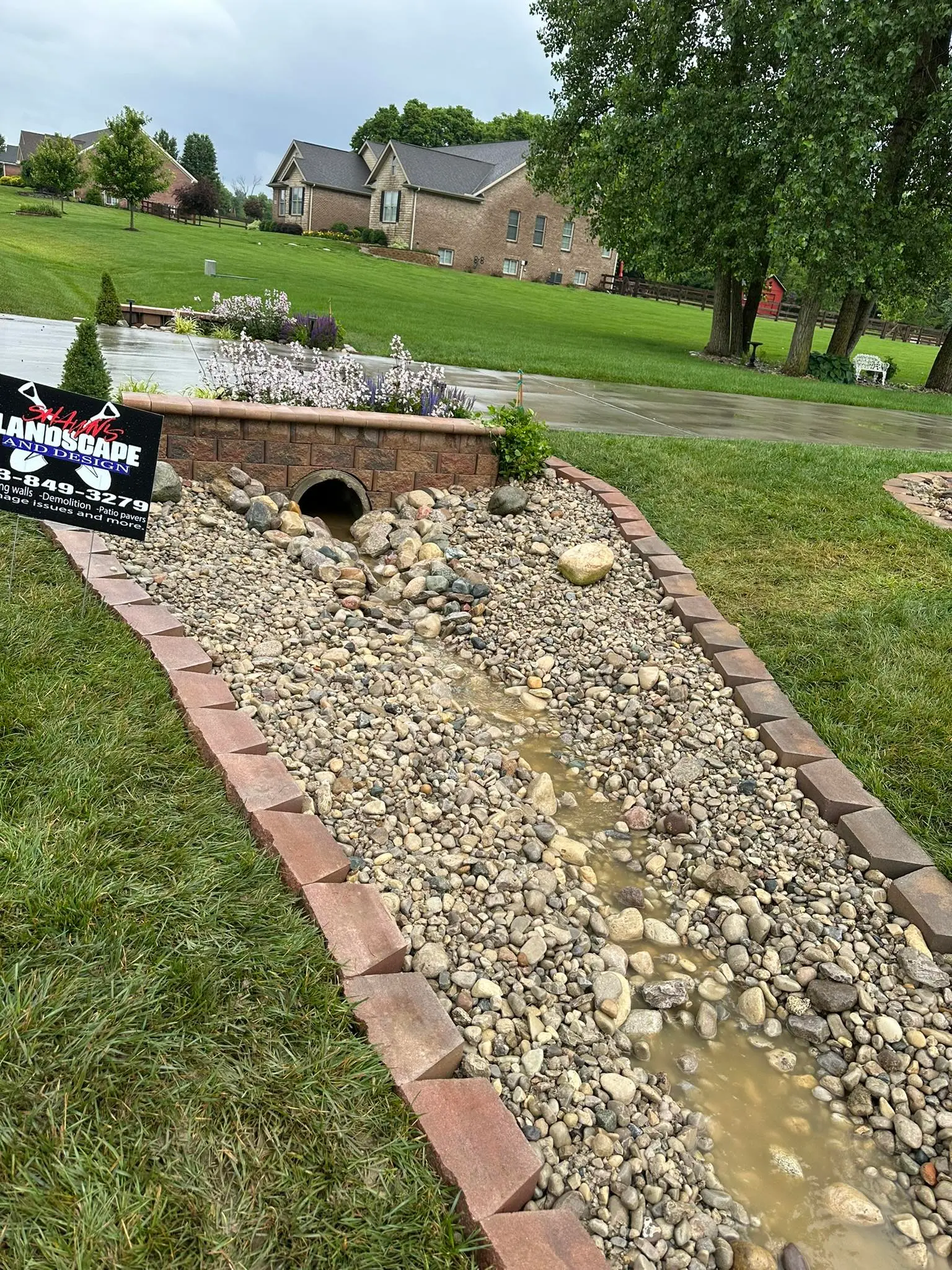
How do you fix standing water around a house foundation?
Standing water creates hydrostatic pressure that threatens structural integrity. We install perimeter French drains and deep catch basins to safely convey the peak rate of runoff away from your foundation.
Why do Fairborn properties need engineered drainage?
Engineered French drains, catch basins, and yard grading to permanently mitigate hydrostatic pressure and foundation moisture.
Fairborn yards split between slow-draining clay on the high ground and fast-draining sand and gravel by the Mad River, and the right fix depends on which one you're on.
Which side of Fairborn your yard sits on decides how the job goes. The high ground is Miamian silt loam over glacial till, 35 to 45 percent clay and slow to very slow to drain at depth. The Mad River side is outwash: Warsaw and Ockley soils over sand and gravel at 17 to 30 percent clay, draining hundreds of times faster than the till. Along the floodplain, Sloan soils are very poorly drained, with a water table anywhere from a foot below the surface to a foot above it from November through June. About half the soils in the Fairborn watershed are hydric, which means they formed wet. On the till a low spot holds water for days, and a downspout that empties next to the house keeps it there. On the outwash, water leaves on its own once the grade sends it the right way, which is a smaller job. On Sloan ground a wet-season dig means working in standing water, so timing is part of the price.
Pricing comes from an on-site look, not a phone guess.
Under all of it, glacial drift runs from single digits deep on the eastern uplands to more than 300 feet in the buried valley. An east-side excavation can reach rock fast, which changes the machine and the price. A west-side dig can go as deep as the job needs without ever seeing it.
Fairborn straddles a drainage divide, with five sub-watersheds spread across two river basins, so where your water ends up depends on your street. Beaver Creek runs through town and carries Zone AE floodplain and regulatory floodway with it. Little Beaver Creek is a different stream three miles away that drains to the Little Miami. Hebble Creek runs channelized and partly piped underground. The city sits on the Buried Valley Aquifer, a Sole Source Aquifer since 1988. Ohio EPA puts the water table less than 20 feet down, and one ODNR monitoring well reads between 2.9 and 6.4 feet. Near the Huffman Dam basin, about 1,900 parcels sit under Miami Conservancy District easement. If your yard backs onto Beaver Creek, check the flood map before anyone brings in fill. North Fairborn backyards near Hebble Creek are the ones that flood in a spring thaw. A water table that shallow is why some Fairborn basements seep even when the grade outside is right. On an easement parcel, check your deed before planning a big fill.
Sources: USDA-NRCS Soil Data Access, SSURGO survey OH057 clipped to the Fairborn city boundary, with the Miamian, Warsaw, Ockley and Sloan Official Series Descriptions; Ohio EPA HUC-12 hydric soil figures; pulled 2026-09-10, https://sdmdataaccess.sc.egov.usda.gov/; ODNR Division of Geological Survey, bedrock geology and drift thickness maps, https://ohiodnr.gov/discover-and-learn/safety-conservation/about-odnr/geologic-survey, pulled 2026-09-10; USGS Watershed Boundary Dataset and GNIS; FEMA National Flood Hazard Layer (CID 390195), https://msc.fema.gov/; Ohio EPA source water assessment; ODNR monitoring well CL-10; EPA Sole Source Aquifer designation, 53 FR 15876 (1988-04-14); Miami Conservancy District flood storage basin rules; pulled 2026-09-10
In Fairborn, we regularly work in Linden Heights, Hebble Creek and North Fairborn.
Learn more about our drainage approach, pricing factors, and process. Or pick up the phone and describe what you're seeing.
COMMON SYMPTOMS WE FIX IN FAIRBORN
Why is my backyard a swamp after it rains?
This is severe surface water accumulation resulting directly from the impermeable nature of local hydrated clay soils. Once the clay reaches its hydration capacity, water has nowhere to go but up.
Why is my grass dying in low spots?
Prolonged submersion in saturated clay deprives root systems of vital oxygen, causing root rot and creating breeding grounds for pests.
"Communication was awesome. He was very prompt in coming out, he did everything I asked and more. I would definitely recommend him and will use him again."
Lori F.
How do you avoid a bad drainage contractor in Fairborn?
Major drainage projects are intimidating. We eliminate the stress, hidden fees, and property damage associated with fly-by-night contractors.
- ✔ Property Protection We utilize heavy-duty plywood track mats and mandate 811 utility locating services prior to arrival to ensure zero damage to your existing driveway or underground utilities.
- ✔ Transparent Pricing We conduct precise topographical laser measurements prior to issuing quotes, eliminating financial "surprises" and transferring the risk from the homeowner to us.
FAIRBORN DRAINAGE FAQS
How much does drainage cost in Fairborn?
Drainage projects in Fairborn start at $3,500. Cost depends on trench length and depth, soil and access, outlet engineering, and restoration. Pricing comes off a laser topographical measurement taken during the free estimate, so there are no hidden fees. Call (513) 849-3279.
Will heavy equipment destroy my Fairborn lawn?
No. We put heavy-duty plywood track mats down under any machinery that crosses your lawn, and we put the turf and beds back when the job is done.
Prefer to start online? Tell us about your drainage project and we'll call you back with a straight answer.
REQUEST A FREE ESTIMATE ONLINE