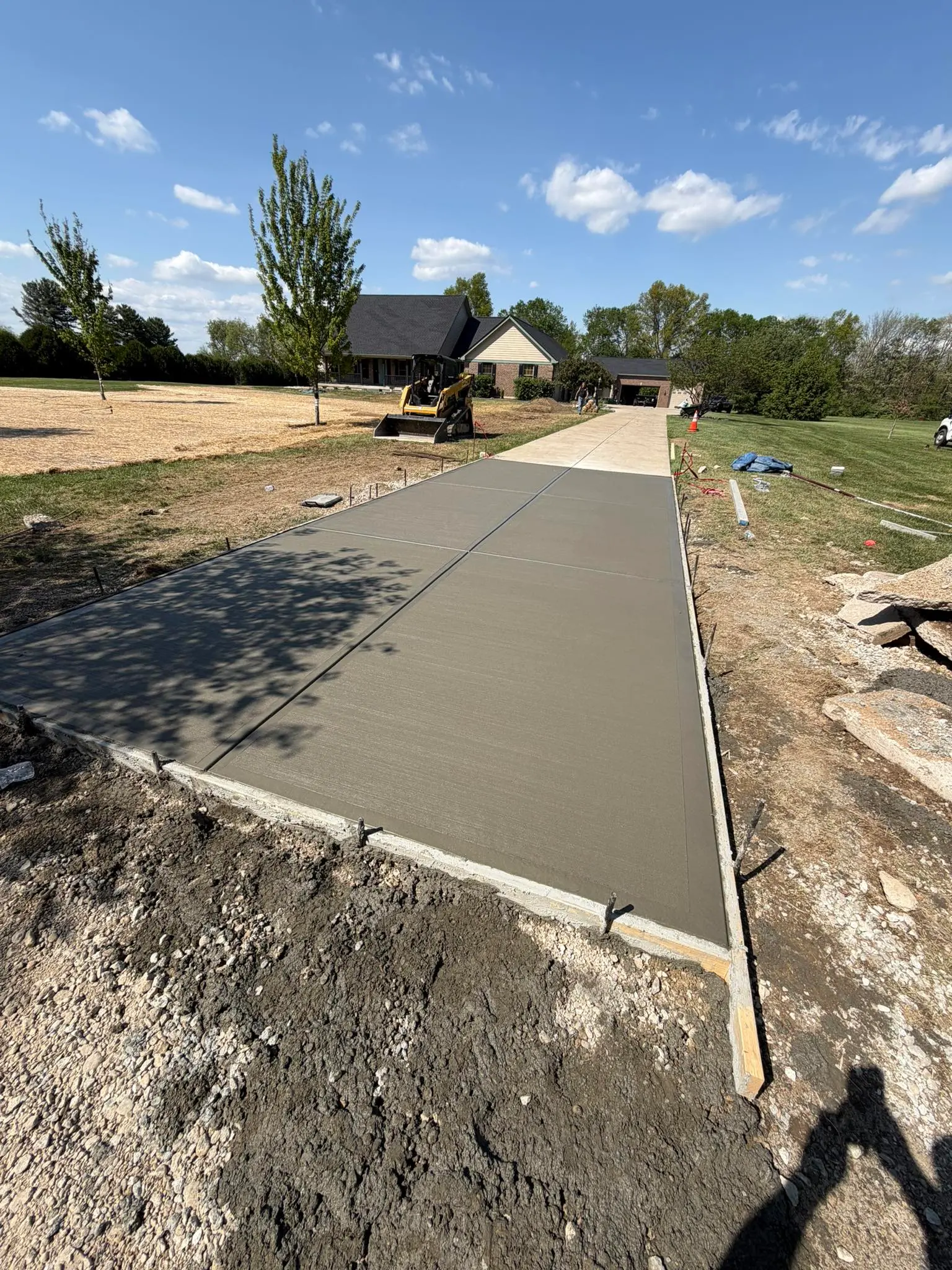
Who handles concrete in Beavercreek, OH?
Shawn's Landscape handles concrete in Beavercreek, Greene County, Ohio. That covers Seajay Acres, Grange Hall Estates, and Fairfield Commons Corridor. Projects start at $3,500. Cost depends on square footage and thickness, tear-out and haul-off, base preparation, and finish and details. Pricing comes from an on-site look, not a phone guess. Estimates are free. Call (513) 849-3279.
Why do Beavercreek properties need engineered concrete?
Beavercreek's wetland-adjacent geography makes yard drainage essential.
The Soil Challenge: Beavercreek sits on Miamian silt loam over the Wisconsinan till plain, formed in up to 18 inches of loess above loamy till. Miamian runs 35 to 45 percent clay in the subsoil, averaging about 38 percent, and falls in hydrologic soil group C. It is classed as well drained, which misleads people here: it carries a perched water table 2.5 to 3.5 feet down from January through May, and a dense till layer averaging 31 inches down that water will not pass. Bedrock is rarely the obstacle on a residential dig in Beavercreek. The till is. Greene County Building Regulation sets footing depth at 32 inches, which puts most footings right into that dense layer.
The Hydrology Reality: Two creeks run through Beavercreek and both feed the Little Miami. Beaver Creek drains 22.7 square miles over 11.4 miles, and Little Beaver Creek drains 26.5 square miles over 9.4 miles before joining it about a mile above the mouth. The Beaver Creek watershed is 58 percent impervious, against the 10 percent mark where stream degradation typically starts, so runoff here arrives fast and concentrated. The Beaver Creek Wetlands are groundwater-fed fens over a buried preglacial valley, where the water table sits close enough to the surface that drainage cannot be engineered away. FEMA maps AE, floodway and X zones inside the city on a Greene County FIRM effective March 16, 2011. Known trouble spots include US 35 at Factory Road and Willowcrest Drive along Grange Hall Road.
Learn more about our concrete approach, pricing factors, and process. Or pick up the phone and describe what you're seeing.
COMMON SYMPTOMS WE FIX IN BEAVERCREEK
Why is my concrete driveway cracking and spalling after only a few winters?
Southwest Ohio subjects concrete to more than 50 freeze-thaw cycles annually. Slabs poured without fiber reinforcement, proper control joints, or adequate base thickness absorb this stress into the slab itself — causing surface spalling and map cracking within 3 to 5 years. We use fiber-reinforced 4,000-PSI mix, saw-cut control joints at prescribed intervals, and expansion joints at all abutting structures to channel stress away from the slab field.
Why is one side of my concrete slab sinking while the other side is level?
Differential settlement results from non-uniform base compaction, clay erosion beneath the slab, or organic material left in the sub-base that decomposes over time and creates voids. We remove all soft material, compact a minimum 6-inch aggregate base in lifts, and verify compaction density before the pour so the slab has a uniform foundation to bear on.
What is the minimum concrete thickness for a driveway that will survive Ohio winters?
Four inches over a properly compacted base is the residential minimum; we recommend 5 inches for driveways bearing vehicle loads heavier than a standard passenger car. Thinner pours may pass visual inspection at install but will crack under the first combination of freeze-heave stress and a loaded axle — costing far more in replacement than the saved material.
"Our basement had flooded due to 5 inches of rain. Shawn corrected the drainage and grading issues, raised the yard so everything drains properly, and replaced failing concrete with a proper crushed limestone base."
Harold M.
How do you avoid a bad concrete contractor in Beavercreek?
Major concrete projects are intimidating. We eliminate the stress, hidden fees, and property damage associated with fly-by-night contractors.
- ✔ Site Protection Protocol We saw-cut control joints within 24 hours of pour to channel crack propagation to planned seams, and install expansion joints at every abutting structure to prevent blow-up. Fiber reinforcement is standard in every mix to suppress micro-cracking during cure.
- ✔ Transparent Pricing We perform a GPR (ground-penetrating radar) scan of the pour zone to locate buried utilities and existing infrastructure before calculating cubic yard volume. Your quote reflects measured quantities — no material-overage invoices after the truck leaves.
- ✔ Bureaucratic Shield New driveway aprons connecting to public roads require a Warren County right-of-way permit. We prepare and submit this permit so your project does not stall at the curb cut.
- ✔ Liability Coverage Every flatwork installation is pitched at a maximum 2% cross-slope to meet ADA accessibility standards and municipal drainage code, protecting you from slip-and-fall liability and neighbor runoff disputes.
- ✔ Completion Guarantee Your contract specifies the pour date and a 28-day cure monitoring protocol. We are reachable during the entire cure window and warrant the finished surface against premature scaling or delamination caused by installation error.
BEAVERCREEK CONCRETE FAQS
How much does concrete cost in Beavercreek?
Concrete projects in Beavercreek start at $3,500. Beavercreek sits on Miamian silt loam over the Wisconsinan till plain, formed in up to 18 inches of loess above loamy till. Miamian runs 35 to 45 percent clay in the subsoil, averaging about 38 percent, and falls in hydrologic soil group C. It is classed as well drained, which misleads people here: it carries a perched water table 2.5 to 3.5 feet down from January through May, and a dense till layer averaging 31 inches down that water will not pass. Bedrock is rarely the obstacle on a residential dig in Beavercreek. The till is. Greene County Building Regulation sets footing depth at 32 inches, which puts most footings right into that dense layer. Pricing comes off a laser topographical measurement taken during the free estimate, so there are no hidden fees. Call (513) 849-3279.
Will heavy equipment destroy my Beavercreek lawn?
No. We utilize heavy-duty plywood track mats for all heavy machinery entering your property and guarantee to restore all turf and landscape features to their original state post-construction.
Are you licensed for earth-moving in Greene County?
Yes. Beavercreek runs its own Storm Water Management code, Chapter 154. A stormwater management plan is required at one acre of disturbance or more, or under an acre when the work belongs to a larger common plan. The clause that catches landscaping carries no acreage floor at all: section 154.03(G)(3) triggers a plan for any activity that modifies an existing or approved drainageway, drainage structure or drainage easement. At-grade work is simpler than most homeowners expect, and the city says so plainly: a poured concrete or paver patio or driveway at grade needs no zoning permit. Retaining walls need one at any height. Building permits come from Greene County Building Regulation rather than the city, and the state exempts walls of four feet or less, measured from the bottom of the footing, unless they carry a surcharge. We handle all required SWCD erosion control submissions and building department permits so you are completely insulated from legal liability and fines.
Prefer to start online? Tell us about your concrete project and we'll call you back with a straight answer.
REQUEST A FREE ESTIMATE ONLINE